top of page


A project containing six of Catt's personal photograph albums, courtesy of the Bryn Mawr College Library.
Undated film but believed to be from early 1930s, provided by Footage Farm, United Kingdom. Contact: info@footagefarm.co.uk.
A project of the Library of Congress, Prints and Photographs Division. Includes portraits, parades, pickets, and cartoons from 1850 to 1920.
External Links
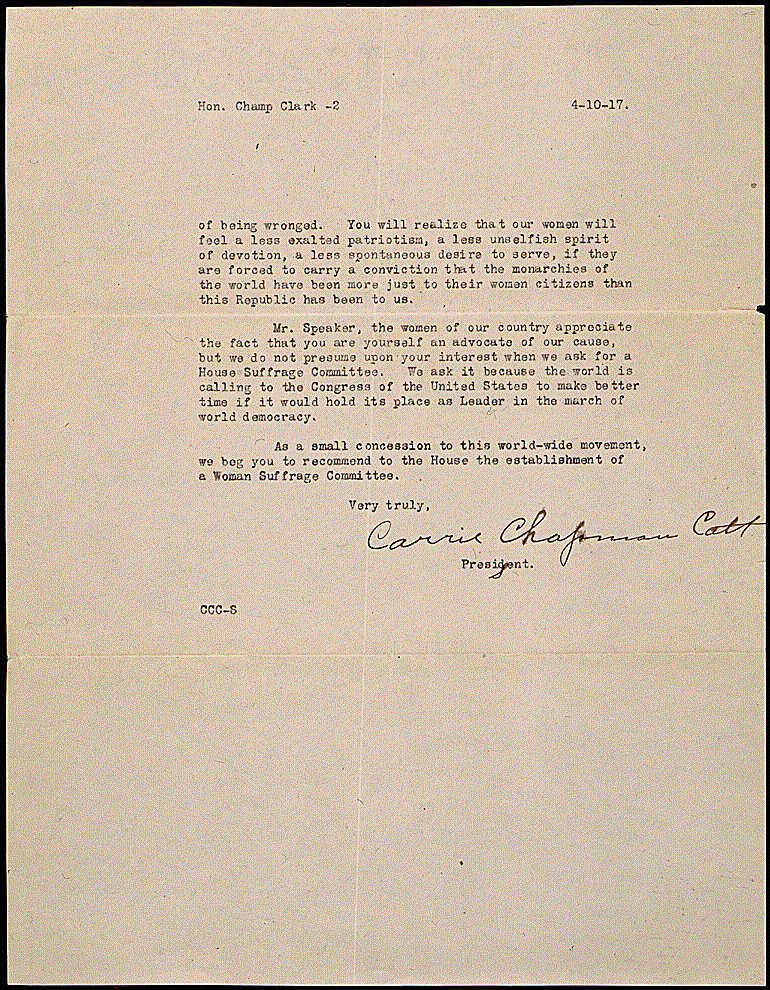
Petition from Carrie Chapman Catt
Petition from Carrie Chapman Catt of the National American Woman Suffrage Association, dated April 10, 1917, seeking appointment of a Committee on Woman Suffrage in the U.S. House of Representatives. Such a committee had already existed in the U.S. Senate. Documents, created in 1917, are courtesy of the National Archives and Records Administration.


The Carrie Chapman Catt Childhood Home near Charles City, Iowa, features a one-acre wildflower and prairie garden, planted just south of the house in late 1997. At one time a walnut grove, the land now features wildflowers and prairie grasses indigenous to the area, including butterfly milkweed, black-eyed Susans, big bluestem, sunflowers, and asters. The land appears much as it did when Carrie lived with her family on the farm during the 1860s and 1870s. A project of the National 19th Amendment Society.
More Views Of The
Carrie Chapman Catt Girlhood Home
The Carrie Chapman Catt Girlhood Home near Charles City, Iowa, is a remarkable combination of Victorian-era charm and Midwestern utilitarianism. The 1866 home is listed in the National Register of Historic Places. A project of the National 19th Amendment Society.
Stroll Among Wildflowers And
Prairie Grasses Near The Home
Workers begin
construction of
the back porch,
on the west side
of the home.
The porch,
featuring a ramp
for wheelchair
access, was
completed in
1998.
Fish-scale
shingles
grace the east,
north and south
sides of the
home
A limestone
foundation
was re-set
providing
strong, stable
support for
the home.


In 1998, the front
porch, a replica of
the original porch,
was attached to
the home's
extrance. It
features
Victorian-era
side rails, spindles
and posts
Restoration
is in
accordance
with the
highest
standards of
achitectural
preservation
Late summer
sunrise view
from the front
porch.
Partridge Pea (Chamaecrista
fasciculata) is an annual species of legume that grows approximately 1.6 feet in height. It has bright yellow flowers from early summer until the first frost. It is pollinated only by bees.
Partridge Pea thrives in areas that have been burned recently before declining in number the following year. It is considered an excellent choice for planting in disturbed areas, as it will quickly cover an area, preventing erosion, while still allowing other plants to become established.

Prairie Blazing Star (liatris
pycnostrachya) Growing to ha height of five feet, this tall grass prairie plant is one of the most noticeable perennials. They bloom from July until frost with fuzzy, purple, thistly-like flowers. Used in gardens as ornamentals,
the roots supposedly taste like carrots. Related species of Prairie Blazing Star were used extensively by Native Americans.

Rattlesnake Master (Eryngium yuccifolium) the leaves of this unique plant look like yucca. It's actually a member of the Parsley Family. The distinctive waxy-green foliage lends the plant a bit of an unusual air, and the white "spiky golf ball" flowers that show up in July are truly unique. Native
Americans brewed a tea of the root as an antidote to rattlesnake venom. It grows three to five feet tall.

Butterfly Milkweed (Asclepias tuberose) This extremely hardy, long-lived perennial is native to North America. The magnificent bright orange flowers are concentrated in compact clusters at the top of branching stems. It grows 12-24 in. tall and flowers June through Sept. The fiovvers produce a large quantity of nectar which attracts butterflies throughout the growing season. Requires a very well-drained sandy or gravelly soil in full sun. Butterfly Weed may take up to tvvo years to become established from seed.

Common Milkweed (Asclepias syriaca) is a perennial flowering
plant that grows in various kinds of soil in sunny areas. The plant grows up to 8 feet in height, has long, broad leaves and purple flowers. It is one of the earliest North American species described in Cornut's 1635 work Canadensium Plantarum Historia. The larva of the Monarch butterfly prefers milkweeds.

Yellow Cone
Photo by: Barbara McKinstry

Gray Headed Coneflower
(Ratibida pinnata) is a perennial
that typically grows from 1.5 to 2.5 feet in height. The plants normally grow one unbranched stem in the wild, but often produce multi-stemmed clumps in gardens. The flower heads are roughly 2 inches wide with drooping, bright
yellow colored petals. The Gray
Headed Coneflower is native to
the United States and is found
growing in dry rocky soils. It
blooms from May into July.

Prairie Cordgrass (Spartina
pectinata) has hard, sturdy,
hallow stems that may reach over 9 feet in height. They grow from a neWvork of woody rhizomes and tough roots that form a sod. The leaves have sharp, serrated edges. This plant prefers an area like a wet prairie or marsh. Mile Prairie Cordgrass is tolerant of water, it does not tolerate prolonged flooding. Livestock may graze on this plant when it is young, but once it matures it becomes very coarse and unpalatable.


Green, left: mare's-tail. Brown,center: curly dock.
Knotweed, foxtail grass. In
lower right comer: Prairie
blazing star [liatris]

Black dots are black-eyed Susans. Also: Indian grass, big blue stem, and daisy fleabane (the lacy, white blurred flowers in center and to the right)

Monarch
Photo by: Barbara McKinstry

Cowslips (Primula veris) is an
evergreen or semi-evergreen
perennial plant growing up to ten inches tall and broad with a
rosette of leaves. The bright
yellow flowers are produced in
spring with 10-30 blooms on a
single stem. The common name, Cowslip, is derived from the old English word for cow dung, because the plant was often found growing amongst the manure in cow pastures. The plant is typically found in open fields and meadovß where there is a moist soil.

Coneflower
Photo by:
Barbara McKinstry

Gray Headed Coneflower (Ratibida pinnata) is a perennial that typically grows from 1.5 to 2.5 feet in height. The plants normally
grow one unbranched stem in the wild, but often produce multi-stemmed clumps in gardens. The flower heads are roughly 2
inches wide with drooping, bright yellow colored petals. The Gray Headed Coneflower is native to the United States and is found
growing in dry rocky soils. It blooms from May into July.

Prairie Cordgrass (Spartina
pectinata) has hard, sturdy,
hallow stems that may reach over 9 feet in height. They grow from a neWvork of woody rhizomes and tough roots that form a sod. The leaves have sharp, serrated edges. This plant prefers an area like a wet prairie or marsh. Mile Prairie Cordgrass is tolerant of water, it does not tolerate prolonged flooding. Livestock may graze on this plant when it is young, but once it matures it becomes very coarse and unpalatable.

Harebell (Campanula rotundifolia) is a perennial species of flowering plant The leaves on the flowering stems are long and narrow The fiovvers usually have five pale to mid violet-blue petals fused together to make a bell shape. The petal lobes are triangular and curve outwards. Seedlings are minute, but established plants can compete with tall grass. Harebell may flower from May to Oct. The flowers are pollinated by bees, but can self-pollinate.

Bergamot (Monarda didyma) is an American herb that was once widely used by Native Americans. It was introduced to the early colonists by the Oswego Indians, and Oswego tea was 4 made by colonists during the time of the • Boston Tea Party. The dark pink, red and purple flowers smell pleasantly of oranges. They attract bees. Bergamot is a perennial that grows best in soil that stays damp in the summer, however it dislikes damp winters. It prefers sun but is adaptable to shade as long as tie soil

Oxeye Sunflower (Heliopis
helianthoides) is an upright,
clump-forming, sunflower-like,
short-lived perennial that is native
to eastern and central North America. It typically grows to 3-4 feet tall and features daisy-like flowers with yellow-orange rays surrounding brownish-yellow center cones. Flowers bloom throughout summer. The Oxeye Sunflower is easily grown in well-drained soil in full sun.

Pale Purple Coneflower (Echinaceacpallida) typically grows from 1.5 toc2.5 feet in height The plants normally grow one unbranchedcstem in the wild, but often producecmulti-stemmed clumps in gardens.cThe flower heads are roughly 2cinches wide with drooping, palecrose-purple or nearly white coloredcpetals. The Pale Purple Coneflowercis native to the United States and iscfound growing in dry rocky soils. Itcblooms from May into July.

Common Sneezeweed
(Helenium autumnale) is a flowering plant that is native to North America.
The plant is found in contiguous mainland United States and most
of Canada. The plant grows up to three feet in height and produces daisy-like flowers in late summer and early fall. Common Sneezeweed is cultivated as a garden perennial.

Evening Primrose (Oenothera
macrocarpa) is a perennial that
blooms in May and June. The
individual flowers are only around for about a day. They first open in the evening and wither the following day. The leaves on the Evening Primrose are narrow and lance-shaped. They are can be up to 6 inches long and most have a silvery sheen due to the many short hairs on the surface of the leaf

bottom of page